
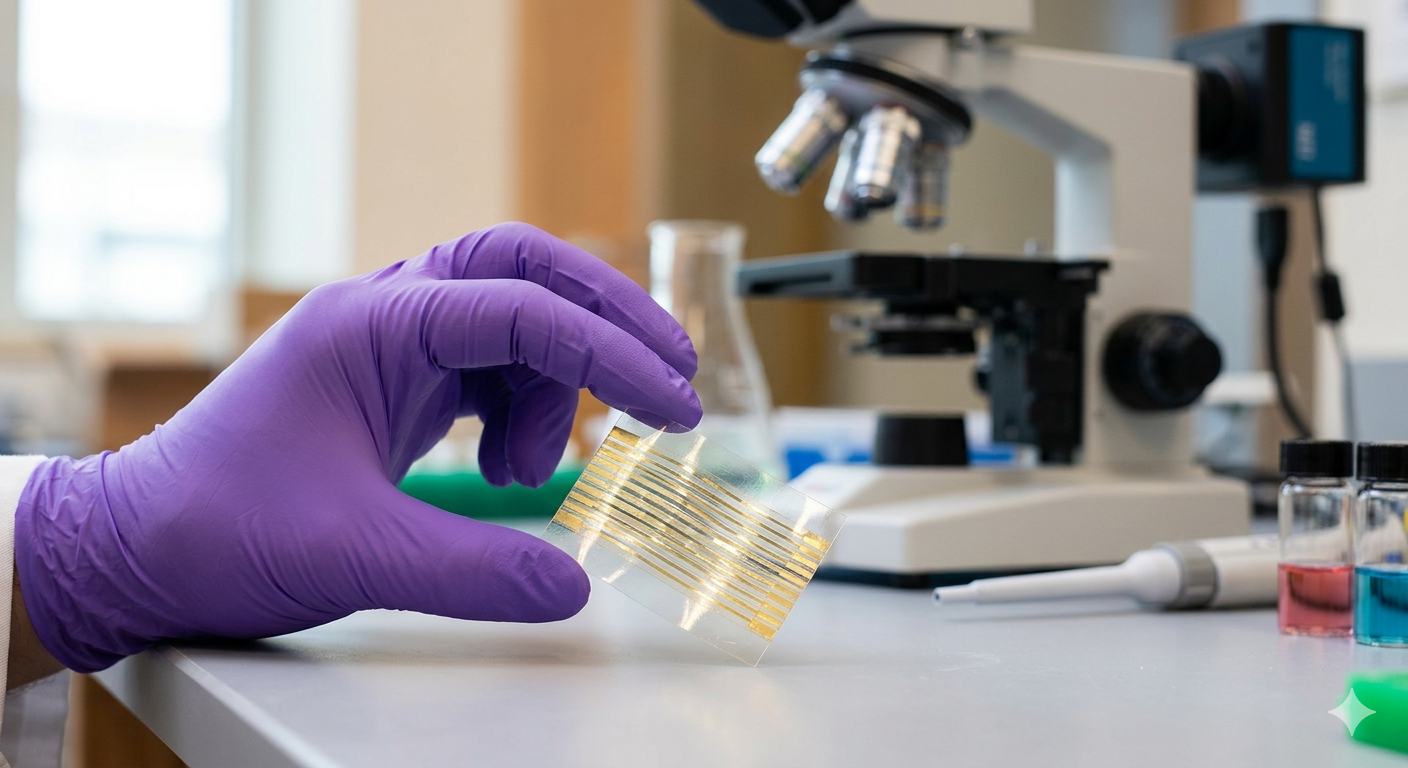
Soft electronics research is currently entering a revolutionary new era thanks to the work of Camille Cunin PhD ’26. While traditional computers rely on rigid, brittle circuit boards, the human body is soft, flexible, and constantly in motion. This physical mismatch has long been a “hard problem” for scientists trying to create medical implants that don’t cause injury or irritation.
At MIT’s Department of Materials Science and Engineering (DMSE), Cunin has spent years developing stretchable, signal-amplifying devices that behave more like human skin than hardware. Her work bridges the gap between synthetic electronics and biological tissue, paving the way for a future where sensors can monitor our health from the inside out without being noticed.
1. Solving the Physical Mismatch Problem: Soft electronics research
The primary challenge in bioelectronics is that human tissue is delicate and pliable, while most conductive materials are stiff. When a hard sensor is placed on a beating heart or a moving muscle, it can lead to scarring or device failure.
Cunin’s soft electronics research addresses this by creating systems that can bend and pull alongside the body. This ensures that the electronics do not fight against the natural movement of biological systems, improving both the safety and the longevity of medical implants.
2. The Mille-Feuille “Crepe Cake” Architecture: Soft electronics research
To make metal stretch like a rubber band, Cunin turned to a surprising source of inspiration: French pastry. She developed a unique “mille-feuille” design for her electronic interconnects.
- Layered Design: The structure consists of a 32-layer stack.
- Material Mix: She sandwiched 16 thin metal layers between 16 layers of porous elastomer.
- Durability: This “crepe cake” style allows the device to remain conductive even when stretched to extreme lengths.
3. Achieving 700% Stretchability: Soft electronics research
In typical soft electronics research, adding more layers usually makes a device more likely to break or peel apart. However, Cunin used a technique called exponential scaling to anchor the metal directly to the porous elastomer.
This created a vertical percolation effect, allowing electricity to travel through the stack even if individual layers developed microscopic cracks. As a result, her devices can be pulled to over 700% of their original size without losing their electrical spark. This is far beyond the stretching capacity of the human skin itself.
4. Mastering Polymer “Spaghetti”
The core of Cunin’s device is the transistor channel, which acts as a hub for processing signals. In a wet, biological environment, this channel must allow both electrons and ions to move freely.
Cunin describes the semiconducting polymers she uses as “spaghetti-like” chains. By carefully arranging these chains, she ensured they weren’t too tightly packed (which blocks ions) or too loose (which stops electricity). This optimization allows her transistors to amplify tiny, weak signals from human nerves in real-time.
5. Successful In Vivo Testing
Cunin’s soft electronics research didn’t just happen on a lab bench; she proved her technology works inside living organisms. Working with animal models, she successfully tested her electrode arrays on the colon of mice.
- Electrophysiology: The devices successfully recorded and stimulated electrical signals in vivo.
- Surgical Integration: Cunin learned surgical techniques to ensure her sensors could be placed and monitored within a living body.
- High Fidelity: The sensors captured clear data that rigid hardware would have struggled to find, all while remaining gentle on the mouse’s tissue.
6. The Role of the OMSE Lab
This research was conducted under the guidance of Aristide Gumyusenge, a professor in the Department of Materials Science and Engineering. Gumyusenge’s lab, known as the Organic Materials for Smart Electronics (OMSE) Lab, provided the interdisciplinary environment necessary for this breakthrough.
Cunin holds the distinction of being the first doctoral student to graduate from the OMSE Lab. Her success is a testament to the collaborative spirit at MIT, where chemistry, structural engineering, and biology intersect to solve global health problems.
7. Advancing Brain-Machine Interfaces
Now that she has completed her work at MIT, Cunin is taking her expertise to Axoft, a neurotechnology startup in Cambridge. She is currently helping to develop soft electrodes for brain implants.
Stiff probes often damage brain tissue over time, but soft electrodes can detect electrical signals without causing long-term harm. This move from the lab to the industry is a vital step in bringing soft electronics research to actual patients who suffer from neurological conditions.
Final Thoughts
The story of Camille Cunin is a perfect example of how “hard problems” in science often require “soft” solutions. By rethinking the very structure of conductive materials, she has moved soft electronics research out of the realm of theory and into the operating room.
Her 32-layer stretchable transistors represent a major leap forward for wearable health tech and brain-machine interfaces. As these devices become more advanced, the line between our bodies and our technology will continue to blur in the best way possible, helping us live healthier, more connected lives.
Would you be willing to use a flexible medical implant if it was safer than a rigid one? Let us know your thoughts in the comments below!
Read Other Interesting news here: Chinese Students Studying Abroad
