
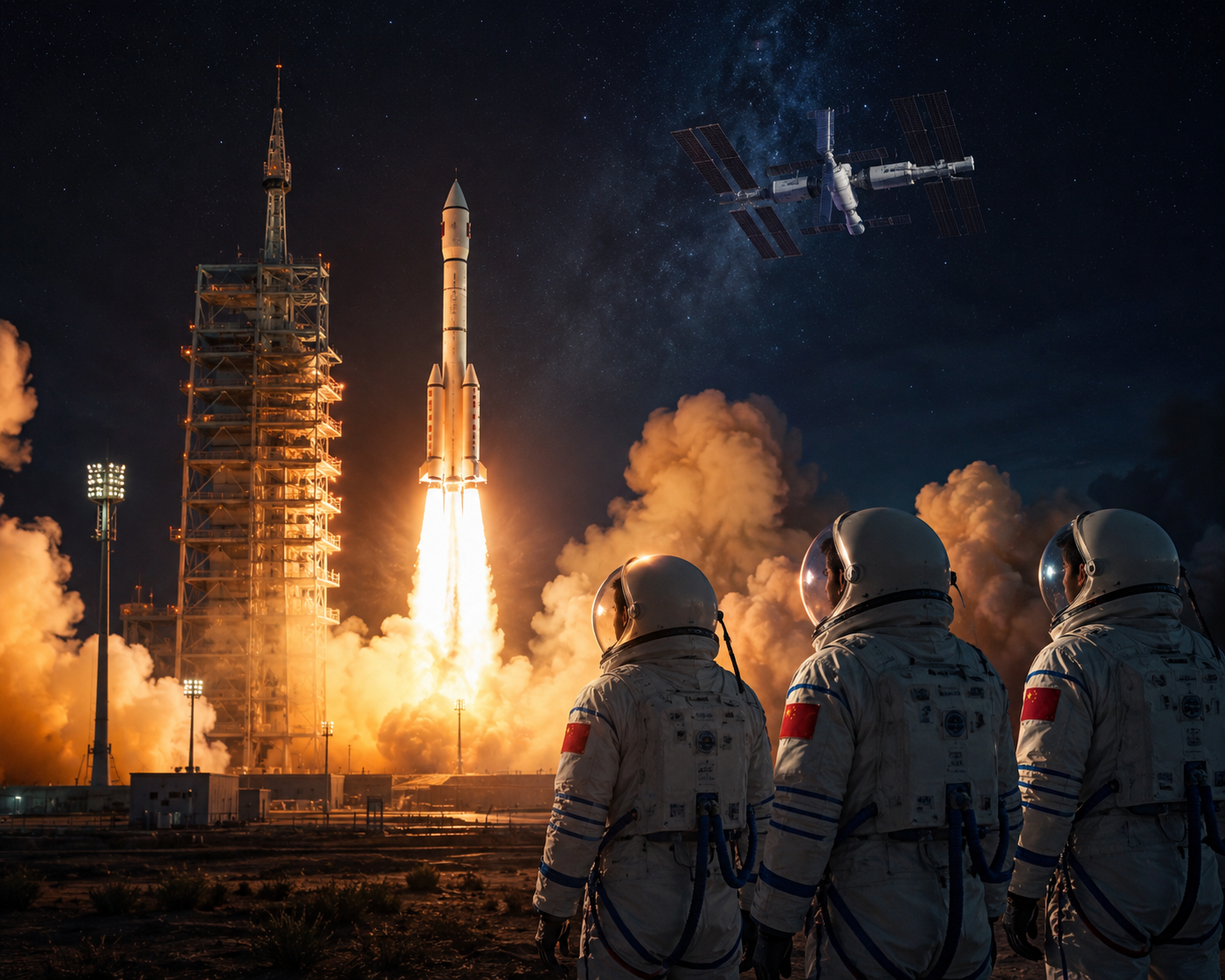
The Shenzhou-23 mission has opened another bold chapter in China’s fast-growing space program. On Sunday, May 24, 2026, China launched a Long March 2-F rocket from the Jiuquan launch centre in north-western China, sending three astronauts toward the Tiangong space station.
This mission is not just another trip to orbit. It is a major step in Beijing’s wider plan to send humans to the moon before 2030. It also includes China’s first plan to keep one astronaut in orbit for a full year.
That makes the mission important for science, space medicine, and China’s long-term lunar goals.
China Launches Three Astronauts Into Orbit: Shenzhou-23 mission
The Shenzhou-23 mission carried three crew members into space aboard a Long March 2-F rocket.
The launch took place at the Jiuquan launch centre, one of China’s most important space facilities. From there, the crew began their journey toward the Tiangong space station, China’s own orbital laboratory.
The mission shows how quickly China’s space program has grown in recent years. What once looked like a slow catch-up effort has now become one of the world’s most active space programs.
Why the Shenzhou-23 Mission Is So Important: Shenzhou-23 mission
The Shenzhou-23 mission matters because it supports China’s bigger dream: landing astronauts on the moon before 2030.
China is using space station missions to build experience. Each mission helps scientists and engineers understand how humans, machines, and life-support systems perform in space.
This launch is especially important because it includes a long-duration space stay. One crew member will spend a full year in orbit, which is a first for China.
That kind of experience will help China prepare for future missions beyond low Earth orbit.
The Crew Includes a Historic Astronaut From Hong Kong: Shenzhou-23 mission
One of the most notable crew members is Lai Ka-ying, aged 43.
He has made history as the first astronaut from Hong Kong to fly into space. Before joining the space mission, he worked for the Hong Kong police.
His role gives the mission a special place in China’s space history. It also brings public attention to how China is expanding participation in its national space program.
Other Crew Members on the Mission
The other two astronauts are:
- Zhu Yangzhu, 39, a space engineer
- Zhang Zhiyuan, 39, a former air force pilot
Both are also part of this important mission to the Tiangong space station.
Their work will support scientific research, long-duration space testing, and future lunar planning.
One Astronaut Will Spend a Full Year in Space: Shenzhou-23 mission
The most powerful part of the mission is the planned year-long stay in orbit.
Until now, China’s Tiangong crews usually stayed in space for around six months before being replaced. This mission changes that pattern.
Chinese officials said the astronaut chosen for the full-year stay will be named later.
A full year in space is a big challenge. It pushes both the human body and spacecraft systems much harder than shorter missions.
Why Long Space Stays Matter
Long missions help scientists study how the human body reacts to space over time.
Researchers pay close attention to:
- Bone density loss
- Muscle weakness
- Radiation exposure
- Sleep problems
- Mental fatigue
- Medical risks far from Earth
These lessons are important for future moon missions and possible Mars missions.
Scientific Research Will Be a Major Focus: Shenzhou-23 mission
The Shenzhou-23 mission is expected to include many science projects.
The crew will work in areas such as:
- Life sciences
- Materials science
- Fluid physics
- Medicine
These experiments can help scientists understand how space affects living systems, materials, and the human body.
Space stations are useful because they offer microgravity conditions that cannot be fully copied on Earth. That makes Tiangong an important research platform for China.
China Is Preparing for Future Moon Missions
China’s moon plan is one of the biggest reasons this mission matters.
Beijing wants to land astronauts on the moon before 2030. To reach that goal, it must test rockets, spacecraft, life-support systems, landing technology, and crew safety plans.
The Shenzhou-23 mission helps build that foundation.
China is also preparing an orbital test flight of its Mengzhou spacecraft in 2026. This spacecraft is expected to replace the older Shenzhou line and support future moon missions.
What Is the Mengzhou Spacecraft?
The Mengzhou spacecraft is part of China’s next stage in human spaceflight.
It is being developed to carry astronauts beyond low Earth orbit. That makes it important for lunar missions and future deep-space travel.
If testing goes well, Mengzhou could become a key vehicle in China’s moon program.
China Wants a Lunar Research Station by 2035
China’s goals do not stop at landing astronauts on the moon.
Beijing also hopes to build the first phase of a manned scientific base called the International Lunar Research Station by 2035.
This plan shows that China is thinking beyond short visits. It wants a long-term presence on the moon.
A lunar research station could support scientific experiments, resource studies, and future exploration missions.
Pakistan May Join China’s Space Station Program
Another important detail is China’s plan to welcome its first foreign astronaut to the Tiangong space station.
According to the report, that astronaut is expected to come from Pakistan by the end of this year.
This would mark an important moment for China’s international space partnerships. It would also show how Tiangong may become a platform for cooperation with selected countries.
China’s Space Program Has Grown Fast
China has invested heavily in space over the past 30 years.
Its goal has been to catch up with major space powers such as the United States, Russia, and Europe.
The results have been impressive. China landed the Chang’e-4 probe on the far side of the moon in 2019, becoming the first country to do so. It also placed a rover on Mars in 2021.
These achievements show that China is no longer only following other space powers. It is now setting its own ambitious targets.
Why China Built Its Own Space Station
China developed the Tiangong space station after being excluded from the International Space Station.
In 2011, the United States banned NASA from working with Beijing. That decision pushed China to create its own independent space station project.
Today, Tiangong gives China a permanent platform in orbit. It allows Chinese astronauts to run experiments, test systems, and prepare for future missions.
This independent path has become a major strength for Beijing’s space ambitions.
The New Space Race Is Heating Up
The Shenzhou-23 mission also comes during a new global race to return humans to the moon.
China wants to land astronauts on the lunar surface before 2030. Meanwhile, NASA is pushing forward with its Artemis program.
This competition is not only about national pride. It is also about science, technology, resources, and long-term influence in space.
The moon is becoming important again because it may support future deep-space missions.
Final Thoughts
The Shenzhou-23 mission is a major step for China’s space program. It sends three astronauts to the Tiangong space station, includes the first astronaut from Hong Kong, and prepares China for a full-year human stay in orbit.
More importantly, the mission supports Beijing’s plan to land astronauts on the moon before 2030 and build a lunar research station by 2035.
China’s space program is moving quickly, and this launch proves that its lunar ambitions are becoming more serious with every mission.
For readers following space, science, and global technology, this is a story worth watching closely.
Read Other Interesting news here: Gaza Attack
