
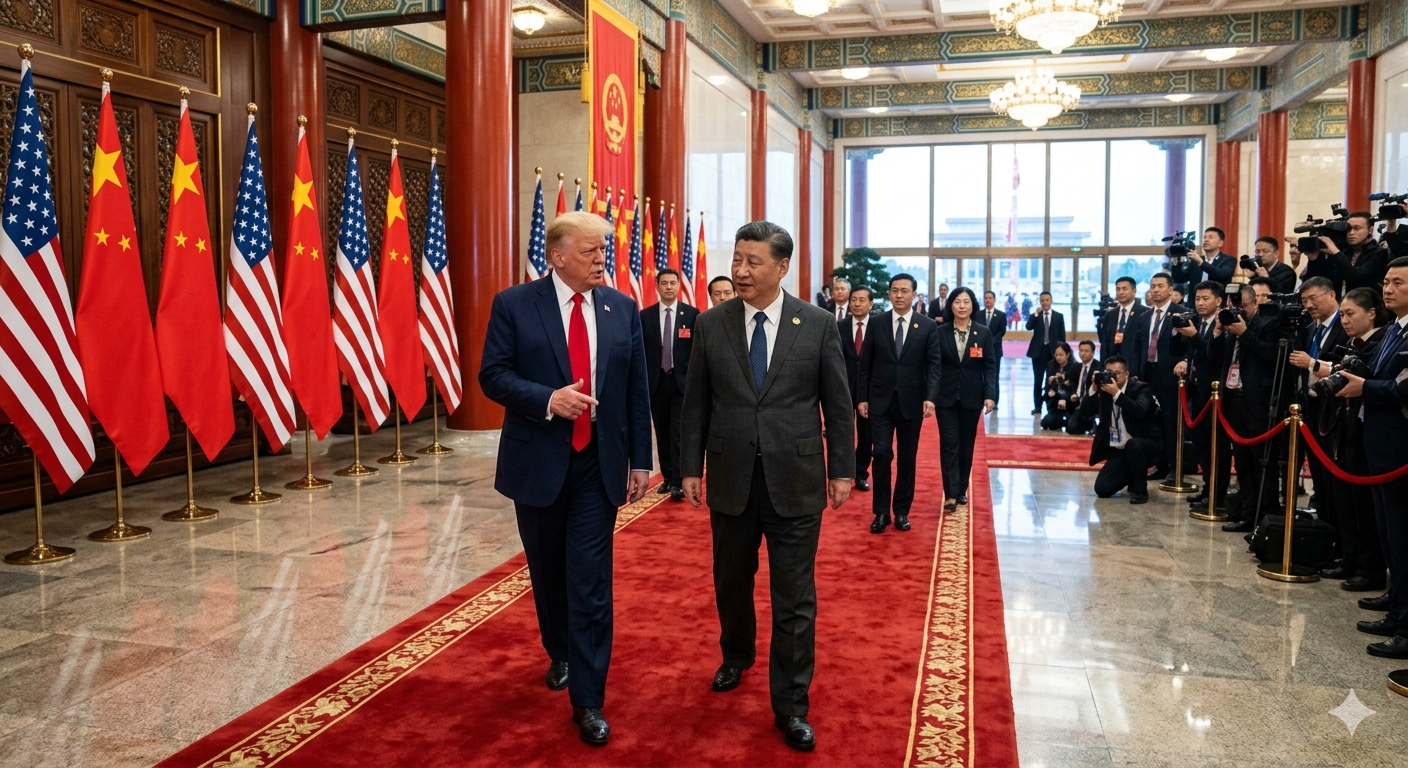
Trump and Xi talks have officially returned to the center stage of global diplomacy as the two leaders meet in Beijing this week. The world watches with bated breath whenever the leaders of the two largest economies sit down at a table. Donald Trump and Xi Jinping have a relationship that has defined the modern era of geopolitics through various Trump and Xi talks. Their interactions are a mix of personal praise, intense trade wars, and sudden diplomatic truces. As Trump prepares for his seventh face-to-face meeting with Xi this week in Beijing, it is the perfect time to look back at how we got here.
This upcoming three-day summit marks the first time a US leader has visited China since 2017. The stakes could not be higher. From the war in Iran to the future of Taiwan and the race for Artificial Intelligence, every word spoken in these Trump and Xi talks will ripple across the globe. To understand the future, we must first revisit the moments that built this complex bond.
The Beginning at Mar-a-Lago (April 2017)
The story of the Trump and Xi talks began in the sun-drenched halls of Florida. In April 2017, Trump hosted Xi at his private Mar-a-Lago resort. This was a critical moment. Trump had just won an election where he frequently criticized China’s trade policies. He had even angered Beijing by taking a phone call from the leader of Taiwan.
Despite the tension, the two leaders seemed to find a personal connection during these initial Trump and Xi talks. Trump told the press that they had made “tremendous progress” in their relationship. However, the shadow of global conflict was already present. While the two men dined, Trump ordered airstrikes on Syria, an ally of China, signaling that American military power would remain active regardless of the hospitality shown at the resort.
From Hamburg to the First Trade War Shots
Just months later, in July 2017, the leaders met again on the sidelines of the G20 summit in Germany. While the public face of the meeting was focused on North Korea and economic ties, the wheels of a trade war were already turning. Shortly after this encounter, the Trump administration launched an investigation into the theft of US intellectual property.
This move laid the groundwork for the punitive tariffs that would eventually define the next several years of Trump and Xi talks. It was a clear sign that while the personal rapport between the two men was friendly, the underlying economic competition was becoming a battleground.
The 2019 Osaka Truce and the Phase One Deal
By June 2019, the trade war was in full swing. The two met in Osaka, Japan, during another G20 summit. The goal was simple: stop the bleeding. They agreed to a temporary halt on new tariffs and an easing of restrictions on the tech giant Huawei.
This led to the famous “Phase One” trade deal signed months later after intense Trump and Xi talks. In this agreement:
- The US agreed to roll back some existing tariffs.
- China pledged to buy $200 billion worth of US goods and services.
- The world hoped for a permanent peace, but the COVID-19 pandemic soon derailed these plans, and China struggled to meet those massive purchase goals.
The Six-Year Gap and the 2025 Busan Summit
The world changed significantly between 2019 and 2025. For six years, the two men did not meet in person. The rivalry intensified, and the tariff war spiraled out of control. By the time they met again for Trump and Xi talks in Busan, South Korea, in October 2025, the US and China had imposed staggering duties of 145 percent and 125 percent on each other.
The Busan meeting was a desperate attempt to extend a truce. After their talks, they announced a one-year pause in the trade war. China agreed to drop some export restrictions on rare earth minerals, which are vital for American tech and defense. In exchange, the US eased some of its heavy tariffs. Trump described the meeting as “amazing,” rating the talks a “12 on a scale of one to 10”.
Key Issues for the May 2026 Beijing Summit
Now, the focus shifts to the present. The latest round of Trump and Xi talks is set to begin this Wednesday in Beijing. This is not just a follow-up; it is a critical survival meeting for global stability. Several massive topics are on the table that could change the course of the year.
The Conflict in Iran
A major cloud over the summit is the ongoing war involving Israel and Iran. Trump is expected to apply significant pressure on Xi during their Trump and Xi talks to stop buying Iranian oil. Washington wants Beijing to use its influence to push Tehran toward a peace deal. With oil prices surging, the outcome of this discussion will directly affect gas prices across the United States.
Trade, Investment, and Rare Earths
Beyond the war, the two nations are trying to build more permanent trade structures through these Trump and Xi talks. Officials have teased the creation of two new bodies:
- A Board of Trade: To determine what goods can be traded without crossing national security lines.
- A Board of Investment: To handle specific roadblocks for companies looking to invest in either country.
- Rare Earth Minerals: Ensuring a steady flow of these materials from China to the US remains a top priority for the Trump administration.
The Future of Technology and AI
The race for Artificial Intelligence is the new frontier of the US-China rivalry. Trump’s team is reportedly worried about the advanced AI models being developed in China. One goal of the Beijing summit is to use the Trump and Xi talks to open a “channel of communication” on AI to avoid accidental conflicts or a dangerous tech arms race.
The Tension Over Taiwan
No discussion between these two is complete without mentioning Taiwan. Xi Jinping remains frustrated with Washington’s role as the primary arms supplier for the island. Meanwhile, Trump has signaled he will continue to discuss arms sales during this visit. In Taiwan, many citizens are already taking self-defense courses, fearing that the diplomatic tension in Trump and Xi talks could one day turn into a physical conflict.
Final Thoughts
The history of Trump and Xi talks shows a pattern of high-intensity conflict followed by calculated cooling-off periods. While both leaders use strong language to protect their national interests, they have consistently shown a willingness to step back from the edge when the economic cost becomes too high.
The May 2026 summit in Beijing is a chance for Trump and Xi talks to move past temporary truces and toward a more predictable relationship. Whether they can agree on the war in Iran or the future of AI remains to be seen. One thing is certain: the decisions made this week will shape the global economy for years to come.
Stay tuned for more updates as we follow the developments from this historic meeting.
Read Other Interesting news here: Hantavirus Cruise Passengers
